Arduino The Documentary (2010) English HD from gnd on Vimeo.
Arduino The Documentary 2010
Arduino The Documentary (2010) English HD from gnd on Vimeo.
Arduino The Documentary 2010
The 28 volunteers in the Princeton study were given 90 seconds to try to memorise a list of seven features for three different species of alien.
The idea was to re-create the kind of learning in a biology class. Aliens were chosen to be sure that none of the volunteers' prior knowledge interfered with the results.
One group was given the lists in 16-point Arial pure black font, which is generally regarded to be easy and clear to read.
The other had the same information presented in either 12-point Comic Sans MS 75% greyscale font or 12-point Bodoni MT 75% greyscale.
The volunteers were distracted for 15 minutes, and then tested on how much they could remember.
Researchers found that, on average, those given the harder-to-read fonts actually recalled 14% more.
They believe that presenting information in a way that is hard to digest means a person has to concentrate more, and this leads to "deeper processing" and then "better retrieval" afterwards.
"There's something I need to ask you," the officer continued. "Are you Brooke Henson?"
"Yes," Brooke said into the phone. "That's me."
On the one hand, she had a purse full of proof that she was Brooke: her student ID, a Vermont driver's license, a U.S. passport, an Ohio identification card, a South Carolina birth certificate. She had a part-time job, a rented apartment not far from campus on New York's Upper West Side and a full course load at Columbia, all registered under the name Brooke Henson.
On the other hand, she wasn't Brooke Henson.
She packed a suitcase hastily, grabbed her two Shih Tzus, hailed a cab and headed straight off the grid. By the time New York police came knocking with a DNA test, "Brooke Henson" was long gone.
TURBO from Jarrett Lee Conaway on Vimeo.
Un studiu realizat de un institut german arată să absolvenţii de inginerie şi economie visează la salarii de 9.000-12.000 de euro lunar, adică de 64- 84 de ori mai mari decât salariu minim pe economie.
Veniturile visate de români sunt similare cu ale studenţilor din Slovacia, Polonia, Republica Cehă sau Ungaria, dar sunt de trei sau chiar de cinci ori mai mici decât cele dorite de „omologii” lor din Danemarca, Austria, Franţa, Germania sau Marea Britanie.
„Luând în considerare şi diferenţele economice între ţări, e surprinzător că studenţii români sunt cei care se aşteaptă la cele mai mici salarii din Europa. În fond, educaţia pe care o primesc este cel puţin la fel de bună ca cea pe care o primesc colegii lor europeni”, a explicat, pentru EVZ, Gesa Bartels, marketing expert în cadrul Institutului trendence.
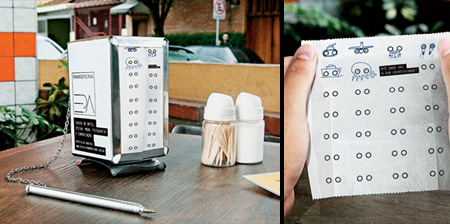
Clever advertising campaign for Panamericana School of Art and Design encourages people everywhere to test their creativity.
The objective is to draw as many things as possible that originate from X’s or O’s. How far does your creativity go?

"Putem sa scoatem sigla Ministerului Educatiei, Cercetarii si Inovarii de pe toate diplomele pe care astazi invatamantul superior le elibereaza. Scoatem sigla si universitatea iti asuma integral responsabilitatea pentru diploma pe care o da.

Satre Stuelke seems to have three passions: McDonald's fast food, toys, and gadgets—specially the GE 4-slice medical research scanner he uses to create these stunning images and videos at Cornell University's Biomedical Imaging Centre.
The dirty secret of higher education is that without underpaid graduate students to help in laboratories and with teaching, universities couldn’t conduct research or even instruct their growing undergraduate populations. That’s one of the main reasons we still encourage people to enroll in doctoral programs. It is simply cheaper to provide graduate students with modest stipends and adjuncts than it is to hire full-time professors.
In other words, young people enroll in graduate programs, work hard for subsistence pay and assume huge debt burdens, all because of the illusory promise of faculty appointments. But their economical presence, coupled with the intransigence of tenure, ensures that there will always be too many candidates for too few openings.